
Lake Baikal: The Deepest Lake on Earth
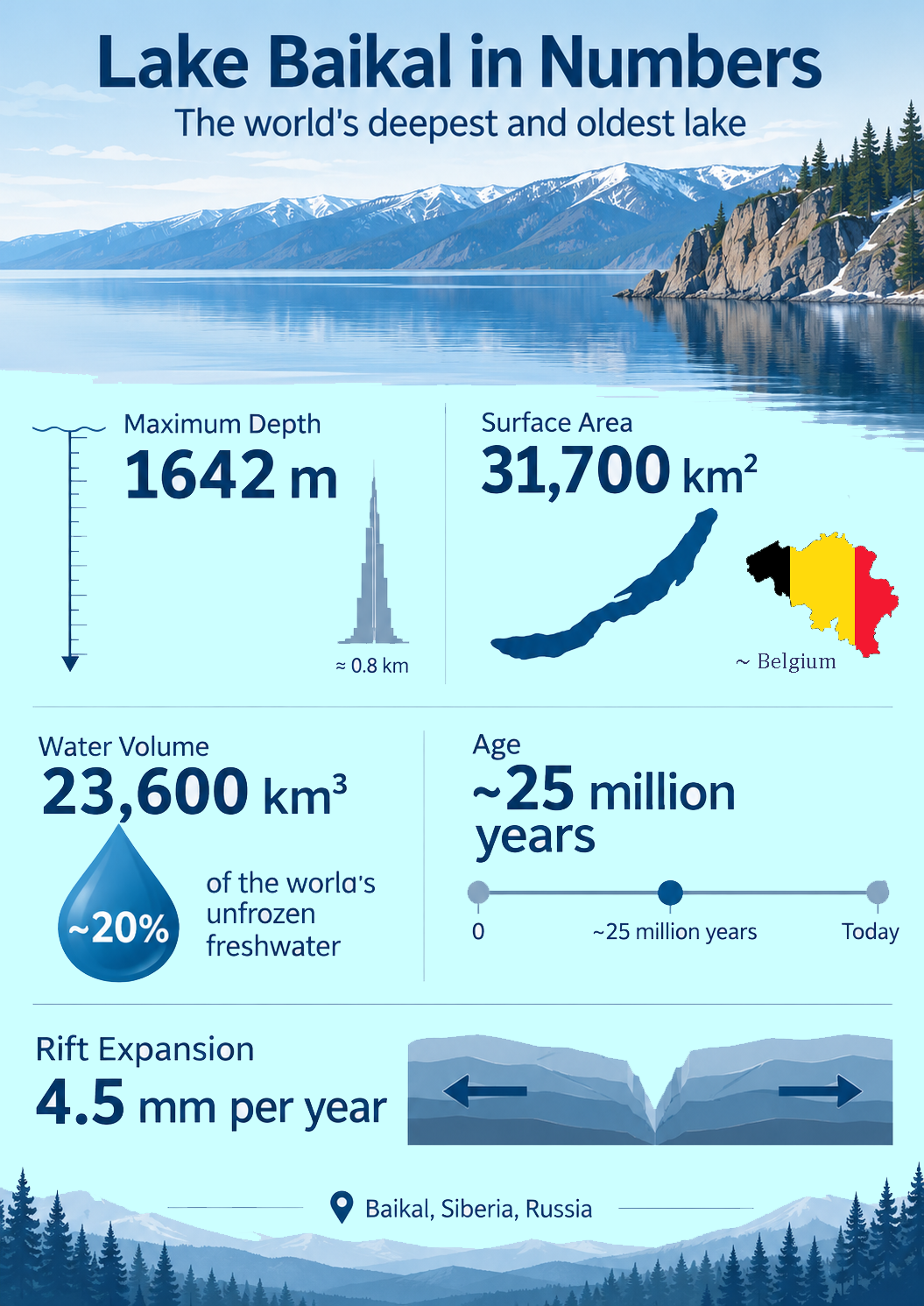
Lake Baikal in Numbers
- Maximum depth: 1642 m
- Surface area: 31,700 km²
- Water volume: 23,600 km³
- Age: ~25 million years
- Rift expansion: 4.5 mm per year
Lake Baikal: Not a Brochure, but a Personal Experience
So much has been said about Lake Baikal that any new text risks turning into yet another promotional brochure with a set of «the deepest, the oldest, the clearest.» These figures are true, but they no longer work — the reader has seen them dozens of times. The only thing truly worth saying about Baikal is what you will feel when you find yourself on its ice or on its shore. Not the «pearl of Siberia» from a guidebook, but your own experience, unlike anything else.
And this experience has specific entry points that don’t boil down to postcard views.
In winter, Baikal makes sound. If you lie down on the ice and stay still, you can hear a low, rhythmic hum — it’s compared to the beat of a drum. This is not mysticism and not the «voice of the lake’s spirit,» but the sound of underwater currents colliding with the ice at a depth of two to three meters. But the explanation doesn’t spoil the impression at all: the sound comes from beneath you, from the water column, and it cannot be confused with anything else.
The ice here is not just clear — it is informative. Frozen methane bubbles rise from the bottom and freeze at different levels, creating vertical columns and patterns that can be seen right through. And in Chivyrkuysky Bay, waves crash against the rocks with such force that spray flies up to eight meters, freezes, and over several months «dresses» the shore in ice grottoes with icicle-stalactites. Each year they are different — because the weather on Baikal is unpredictable, and the ice never repeats itself.
In summer or in the shoulder season, a different optic works. Baikal remains a «laboratory of evolution»: out of more than two thousand species of plants and animals, almost two-thirds are found nowhere else on Earth. But you can see this not in an encyclopedia, but on the shore — in the way local life is organized, in the attitude toward the lake as a living being, with rituals and offerings before a journey. This is not a tourist attraction, but part of everyday life that can only be read through personal contact.
And one more thing that rarely makes it into glossy texts. Baikal today is not only «purity» and «sacredness.» It is a place where science is trying to understand what is happening to the ecosystem: autonomous underwater vehicles are exploring mud volcanoes at the bottom, checking whether volcanic activity there has ended. This is not alarming news and not a cause for panic, but it is honest context: the great lake is not a frozen picture, but a living system that is changing, and humans are trying to keep up with these changes.
Therefore, the best advice one can give before a trip to Baikal is not to compile a «must-see» list from someone else’s selections. Buy a ticket, check your visa, fly to Irkutsk or Ulan-Ude, and let the lake do to you what it does to everyone: make you fall silent and listen. The rest — the ice, the grottoes, the bubbles, the hum — will follow.
See you by the water.